

Microbiological surveillance is designed to identify contamination. But what happens when the equipment used to collect the sample becomes a potential source of contamination itself?
In endoscopy, patient safety, infection prevention and reliable microbiological surveillance go hand in hand.
With the release of the Infection Prevention and Control in Endoscopy 2025 Update and the introduction of AS 5369:2023, healthcare facilities have an important opportunity to review not only how they reprocess their endoscopes, but also how they collect microbiological surveillance samples.
One question deserves particular attention:
Could your reusable sampling tubing be compromising the reliability of your microbiological surveillance results?
At Endomed, we believe microbiological surveillance should be simple, consistent and designed to minimise avoidable contamination risks.
That’s why we introduced EndoMicro — an all-in-one microbiological endoscope surveillance sampling system.
Why Microbiological Surveillance Matters
Microbiological surveillance plays an important role in verifying the effectiveness of endoscope reprocessing and identifying potential contamination.
The GESA and GENCA Infection Prevention and Control in Endoscopy 2025 Update, particularly Chapter 10, reinforces the importance of microbiological surveillance as part of a comprehensive quality management program.
The guidance includes recommendations for surveillance frequency, sampling methods, laboratory testing and responses to positive cultures.
However, reliable surveillance depends on more than collecting a sample.
The integrity of the sampling process is essential to ensuring that the results accurately reflect the condition of the endoscope being tested.
This includes considering the microbiological integrity of sampling accessories, connectors, tubing, collection containers and the environment in which samples are obtained.
The Hidden Risk: Reusable Sampling Tubing
Many endoscopy departments use reusable tubing and connectors during microbiological surveillance.
While appropriately validated and reprocessed reusable equipment can be suitable for its intended purpose, each additional reusable component introduces another process that must be managed, monitored and documented.
Reusable sampling accessories may require:
- Cleaning and appropriate reprocessing between uses.
- Inspection for damage, deterioration or retained contamination.
- Correct drying, handling and storage.
- Documented procedures and staff competency.
- Ongoing assurance that reprocessing remains effective.
If these processes are not adequately controlled, residual microorganisms or contamination introduced during handling may affect the collected sample.
The concern is straightforward: a positive microbiological result may originate from the sampling pathway rather than the endoscope itself.
This possibility creates uncertainty, requiring investigation to establish the source of contamination.
False-Positive Results: The Cost Goes Beyond the Laboratory
Imagine your endoscopy department receives a positive microbiological surveillance result.
Your immediate concern is whether the endoscope has been adequately reprocessed and whether it is safe for patient use.
But what if the contamination originated from the reusable tubing used to collect the sample?
Depending on the organism identified and the applicable clinical guidance, a positive culture may trigger:
- Investigation into the source of contamination.
- Additional endoscope reprocessing and repeat microbiological sampling.
- Temporary removal of the endoscope from clinical use.
- Additional laboratory costs and staff workload.
- Potential disruption to procedure schedules and equipment availability.
Not every positive result requires an endoscope to be quarantined. The GESA/GENCA 2025 guidance provides organism- and endoscope-specific response pathways.
However, where a positive result requires an endoscope to be withdrawn pending further investigation or satisfactory retesting, the operational impact can be significant.
The real cost of a potentially contaminated sample is not simply the price of another test. It is the cost of uncertainty, investigation and potentially avoidable downtime.
Why Choose Single-Use Sampling Components?
Single-use sampling accessories provide an opportunity to eliminate the need to clean, disinfect, dry, store and reuse those particular components between surveillance procedures.
This removes the risk of residual contamination arising from their previous use and reprocessing.
Importantly, single-use does not mean zero contamination risk. Correct handling, aseptic sampling technique, appropriate packaging integrity and adherence to the manufacturer’s instructions remain essential.
The advantages of a purpose-designed single-use sampling system include:
Reduced cross-sample contamination risk
Using a new sampling pathway for each procedure avoids potential carryover associated with inadequately reprocessed reusable tubing.
Greater consistency
Standardised sampling components help establish a repeatable process across staff members, endoscope brands and clinical locations.
Less reprocessing workload
Eliminating the reprocessing of disposable sampling accessories reduces associated cleaning, drying, inspection and storage tasks.
Greater confidence in results
By controlling one potential source of sample contamination, facilities can improve confidence in the integrity of their sampling process.
Potential cost savings
Avoiding sampling-related contamination may reduce unnecessary repeat testing, investigation, staff time and equipment downtime.
AS 5369:2023 — A Risk-Based Approach to Quality Assurance
AS 5369:2023, Reprocessing of reusable medical devices and other devices in health and non-health related facilities, places importance on risk-based quality assurance, documented processes, validation and routine monitoring.
Clause 2.2 addresses the establishment of a risk-based approach to quality assurance, while Clause 8.5 specifically addresses microbiological surveillance of flexible endoscopes with channels.
These principles support healthcare facilities in evaluating potential risks within their reprocessing and surveillance workflows.
From a risk-management perspective, it is worth asking:
If we can remove a reusable component from our sampling process, why introduce an additional reprocessing dependency where a suitable single-use alternative is available? AS 5369:2023 does not specifically mandate the use of disposable microbiological surveillance kits. However, selecting appropriate single-use accessories can be a practical measure within a facility’s broader risk-reduction strategy.
Introducing EndoMicro: A Smarter Approach to Endoscope Surveillance
Endomed has developed the EndoMicro microbiological surveillance sampling system to help endoscopy departments simplify their sampling workflow and reduce reliance on reusable sampling accessories.
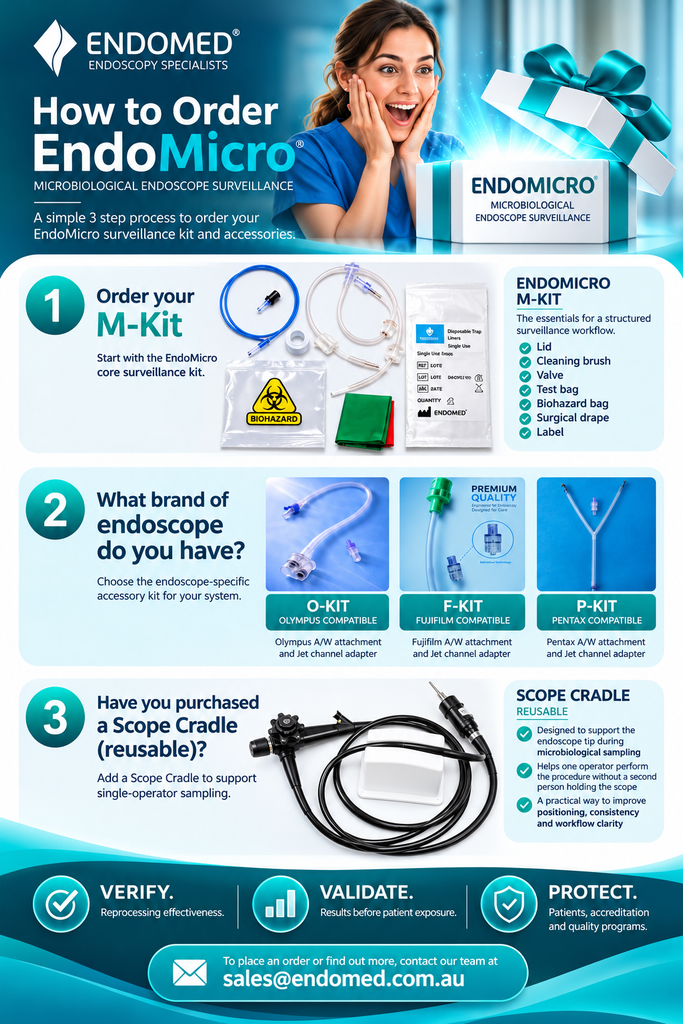
The system follows a straightforward three-step ordering process.
Step 1: Order Your EndoMicro M-Kit
The core M-Kit provides the essential components for microbiological surveillance sampling:
- Lid
- Cleaning brush
- Valve
- Test bag
- Biohazard bag
- Surgical drape
- Label
Step 2: Select Your Endoscope Brand
Choose the compatible accessory kit for your endoscope:
- O-Kit: Olympus-compatible air/water and jet channel connectors.
- F-Kit: Fujifilm-compatible air/water and jet channel connectors.
- P-Kit: Pentax-compatible air/water and jet channel connectors.
Step 3: Add the Reusable Scope Cradle
The EndoMicro Scope Cradle is designed to support the endoscope during microbiological sampling, allowing a single operator to perform the procedure without requiring another staff member to hold the scope.
The reusable cradle supports positioning and workflow consistency and must be maintained in accordance with its instructions for use.
Look Beyond the Purchase Price: Consider the Total Cost of Surveillance
When comparing reusable sampling tubing with a single-use sampling system, the purchase price is only one consideration.
A complete cost assessment should also account for:
| Reusable sampling equipment | EndoMicro single-use sampling pathway |
| Reprocessing labour and consumables | No reprocessing of single-use components |
| Reprocessing validation and monitoring | New components for each sampling procedure |
| Drying, storage and handling requirements | Reduced reusable-accessory handling |
| Potential residual contamination following inadequate reprocessing | Eliminates contamination carried over from previous use of those components |
| Potential repeat sampling and investigation costs | May reduce avoidable sampling-related contamination |
| Multiple components managed individually | Standardised kit-based ordering and preparation |
The potential savings extend beyond consumables.
Every unnecessary investigation, repeat test or period of endoscope downtime can affect departmental efficiency, staff resources and patient scheduling.
The Endomed Difference: Verify. Validate. Protect.
VERIFY. Support effective monitoring of endoscope reprocessing through microbiological surveillance.
VALIDATE. Support reliable sampling and informed quality assurance decisions.
PROTECT. Reduce avoidable sampling risks while supporting patient safety, equipment availability and infection prevention programs.
At Endomed, we believe effective infection prevention begins with thoughtful risk management.
Don’t let the equipment used to test your endoscope become an avoidable source of uncertainty.
Choose a streamlined, purpose-designed sampling solution.
Discover EndoMicro
Contact the Endomed team to learn more about the EndoMicro M-Kit, brand-specific accessory kits and reusable Scope Cradle.
Email: sales@endomed.com.au
Website: www.endomed.com.au
ENDOMICRO — VERIFY. VALIDATE. PROTECT.
References
- Devereaux BM, Jones D, Wardle E, on behalf of the Infection Prevention and Control in Endoscopy Committee. Infection Prevention and Control in Endoscopy 2025 Update. Gastroenterological Society of Australia, 2025. Particularly Chapter 10: Microbiological surveillance cultures, sections 10.4–10.8.
- Standards Australia. AS 5369:2023 — Reprocessing of reusable medical devices and other devices in health and non-health related facilities. Particularly Clauses 2.2 and 8.5.
Clinical note: EndoMicro is intended to support microbiological surveillance workflows. Sampling procedures, accessory compatibility, reprocessing requirements for reusable components and responses to positive cultures must follow applicable clinical guidance, facility protocols and manufacturer instructions. The product is not represented as eliminating all contamination risk or guaranteeing negative microbiological results.